
Chimera Checkpoint 2: The Web Game Renaissance Has Begun
and it's here to stay!

Not every game is built for 100-hour RPG players. Some are built for casual gamers. For a dopamine break between Zoom calls. For a kid on a shared laptop. For someone who wants to click and play, without a download, install, or sign-up screen.
That’s why browser games, once dismissed after the fall of Flash, are quietly, but unmistakably, staging a comeback.
The Adobe Flash Nostalgia
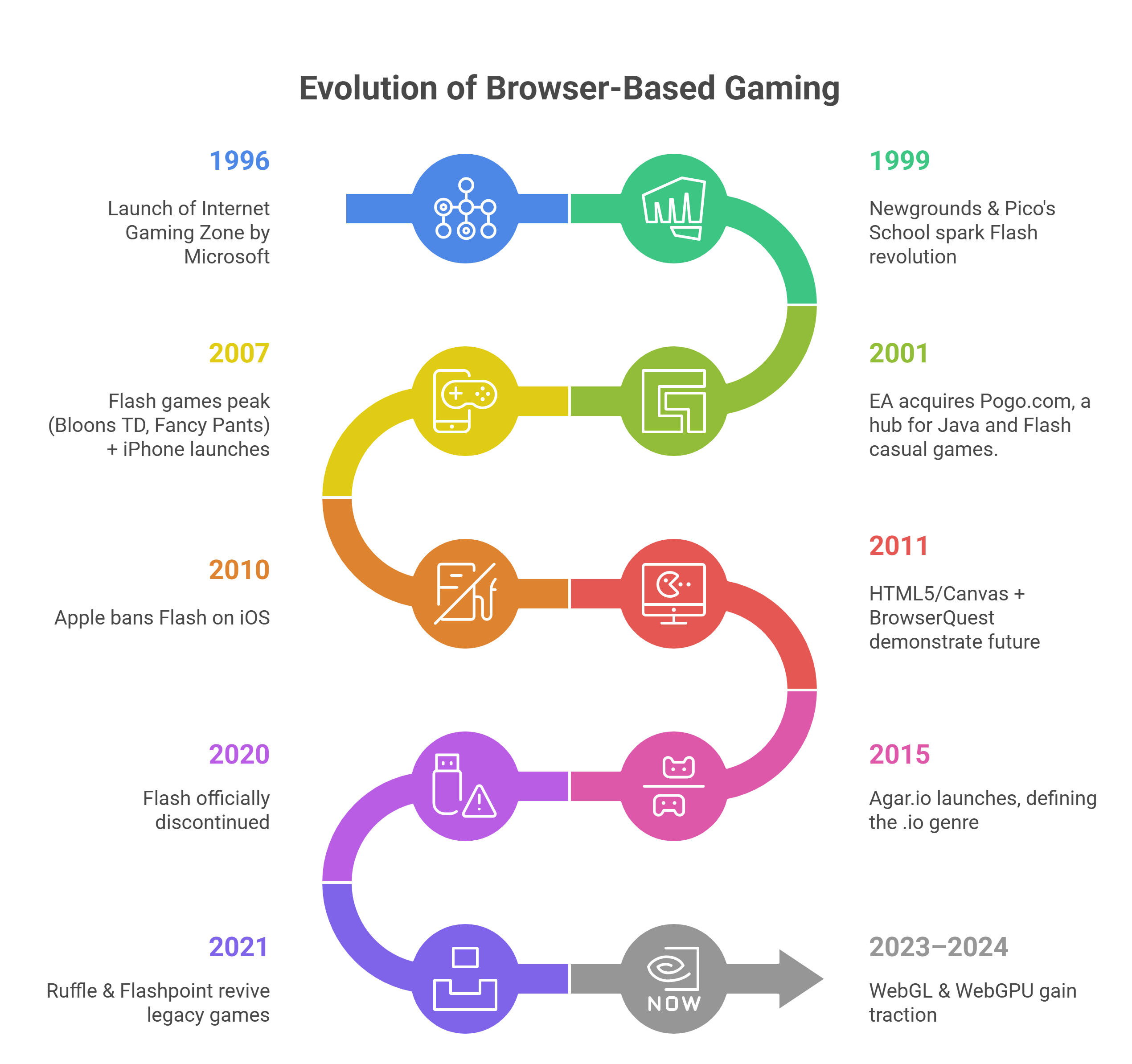
In the 2000s, Flash games like Bloons TD, Raft Wars, and Stick RPG were cultural artifacts. They weren’t “hardcore,” but they were universal, accessible, viral, and surprisingly sticky.
Then Flash died. And it seemed like browser games died with it. But things have changed. The web is no longer a second-class citizen.
Your browser is your new OS (sorta)
Most of us, especially Gen Z and millennials, already live inside the browser. We plan on Notion, talk on Slack, design on Figma, and deploy on Vercel. We spend 6–7 hours a day on browsers. As the browser becomes the OS, games are just catching up.
And the tech has arrived to support it:
WebGL & WebGPU allow console-quality graphics
AI tooling helps devs generate levels, tune difficulty, and ship faster
It’s not just a tech story, it’s a distribution one too. App store cuts are broken. 30% revenue cuts. Murky guidelines. Slow approvals. Web games let devs launch instantly, own their margins, and iterate without gatekeepers.
This is why studios must treat the web not as an afterthought, but as the first launchpad.
Web Is the Launchpad, Not the Leftover
Platforms like Poki (90M+ monthly users) and CrazyGames (35M+) are now proving what web distribution can look like. Developers use them to test mechanics, gauge retention, and build funnels into mobile or premium versions.
Web games are low-friction, low-cost, and high-leverage. They’re made to go viral. And they just might be the next great distribution unlock.
🕹️ Read our full breakdown → [Read More]
Drop Zone
Krafton posts first profit dip in 2 years despite PUBG's strong run [Read More]
Sony sues Tencent over Horizon-style clone by ‘Ace Game Studio’ [Read More]
Playful.AI launches $7K game jam, AI tools mandatory for entry [Read More]
Take-Two: Mobile now 52% of $5.6B in annual revenue [Read More]
Maharashtra calls for a central online gaming law, says state bans don’t work [Read More]
Game We’re Watching!
Game: Lamar – Idle Vlogger
Studio: CrazyLabs
Why It’s Winning:
Big top-of-funnel. Lamar – Idle Vlogger has clocked 19M downloads in the last 90 days and pulled in $410K in IAP revenue, despite a relatively simple core loop. Retention is strong with D1 at 52%, D7 at 20%, and D30 at 5%, all impressive numbers for a simulation-tycoon that leans idle.
Design Notes:
The game’s aesthetic stands out instantly. Its bold, adult-animation-inspired visuals (think Rick & Morty meets gaming) are clearly built to catch Gen Z eyes in crowded app stores. The core gameplay, climb from broke vlogger to viral star, is built on idle mechanics and a steady dopamine drip of upgrades, with humour baked in. However, once progression flattens, the loop can feel repetitive without a strong meta layer to sustain interest.
Mini-Lesson:
Idle loops still work, but packaging matters. Stylised visuals and a relatable fantasy (getting rich on the internet) help Lamar hit massive reach and strong short-term retention, even if long-term depth is thin.
Memes
Nice! You made it to the end.
If you liked this, stick around! We drop sharp insights, spicy breakdowns, and the occasional meme in your inbox every fortnight. Hit subscribe and don’t miss the next drop.